
 By
·
3 minute read
By
·
3 minute read
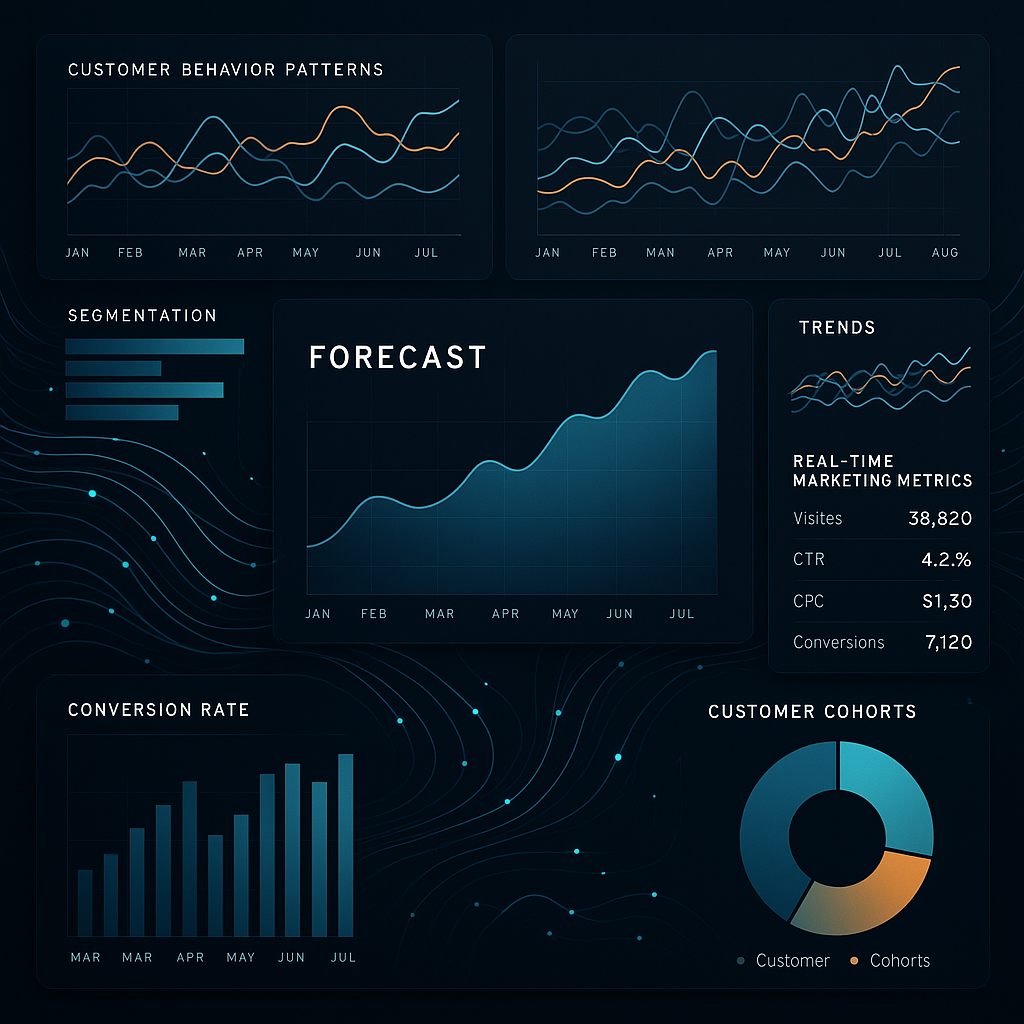
Discover how predictive analytics is revolutionizing marketing strategies, enabling businesses to anticipate customer behavior, optimize campaigns, and drive unprecedented ROI through data-driven insights.
The power of data-driven customer intelligence
Most teams are already sitting on more data than they know what to do with. The gap isn’t data — it’s turning that data into something you can actually use to make better decisions.
That’s where predictive analytics earns its keep. Instead of trawling through reports after the fact, you’re using machine learning and statistical models to spot patterns in behaviour before customers act. Done well, it shifts you from “reacting to what just happened” to seeing likely next steps and planning around them.
The real value comes when you pull together signals from everywhere: website behaviour, email engagement, purchase history, support tickets, even social interactions. Combined, they form a much clearer view of who’s likely to buy, who’s at risk of churning, and where genuine upsell opportunities sit. Businesses that get this right often see conversion rates lift 20–30% and acquisition costs come down because they’re focusing effort where it counts.
Modern predictive tools plug into your existing stack — CRM, marketing automation, analytics — to create that joined-up picture. No more isolated reports in different systems. You get live insight that marketing, sales, and leadership can all act on, and a marketing engine that adapts as customer behaviour changes rather than once a quarter when someone has time to build a slide deck.
Forecasting campaign performance before you hit “launch”
Launching a big campaign and hoping for the best is an expensive way to learn. Predictive analytics lets you do a dry run first.
By using your historical data and current market context, you can model likely engagement, conversion, and revenue impact before you commit real budget. You can test different audiences, channels, timings, and messages on a spreadsheet instead of in the wild — and only back the combinations that look promising.
Stronger models take into account who you’re targeting, which channels typically perform for that segment, time of year, competitive noise, and even creative format. You get early signals about which levers matter most, so you tweak in planning rather than firefighting mid-flight.
At a leadership level, this is about visibility. If you can walk into a board meeting with grounded forecasts — not just “we’ll see how it goes” — marketing starts to look a lot more like a predictable revenue driver than a cost line.
Personalising customer journeys at scale
Personalisation used to mean swapping in a first name. Customers expect much more now — and they can tell when you’re faking it.
The hard bit has always been scale. It’s not realistic for a human to hand-craft journeys for thousands of people. Predictive analytics closes that gap by doing the matching work for you. It looks at individual behaviour and likelihood to act, then automatically selects the most relevant content, offer, or next step.
As people move through their buying journey, the system adjusts in real time. Someone showing strong intent gets more direct product or pricing information. Someone drifting away gets a lighter-touch re‑engagement, not a hard sell. The result is an experience that feels like it “fits” without you needing a room full of marketers pulling levers all day.
Across the whole lifecycle — from first touch to long-term customer — this tends to show up in higher engagement, better conversion rates, and noticeable lifts in customer lifetime value (30–50% in some cases). Not because of tricks, but because more people are seeing something that’s actually relevant to them.
Optimising marketing spend with predictive models
Most budget decisions still rely on a mix of last month’s numbers and gut feel. Predictive models give you something sharper: a live view of where money is most likely to turn into revenue.
By analysing how each channel, campaign, and touchpoint contributes to conversions, predictive attribution moves you past the old “last-click wins” thinking. You see how awareness, consideration, and conversion activity work together — and which parts are quietly doing more than they’re getting credit for.
On top of that, predictive spend tools can adjust budgets in near real time. Underperforming campaigns get dialled down. Channels that are beating expectations get more funding while the opportunity is still there. Teams that adopt this kind of approach often see 15–25% gains in efficiency from the same budget — more qualified leads, more revenue, less waste.
Building a future‑ready marketing infrastructure
You don’t get any of this by just buying another platform and hoping for the best. Predictive analytics only works as well as the foundations underneath it.
First, the data. You need clean, connected data across systems — a proper customer data backbone, sensible governance, and integrations so platforms are talking to each other. If your CRM is a mess and analytics tracking is patchy, that’s where the work starts.
Then, the people. Marketers don’t need to become data scientists, but they do need to be comfortable reading numbers, asking the right questions, and working with analysts or data teams. In our experience, the best setups treat predictive as a shared capability: marketing, data, and tech working together rather than in silos.
Finally, the way you work has to support continuous optimisation. Annual plans with rigid budgets and fixed campaigns don’t line up well with a predictive approach. You need room for test‑and‑learn, shorter feedback loops, and the discipline to act on what the models are telling you — even when it challenges old assumptions.
If you put those pieces in place now, you’re not just chasing short‑term gains. You’re building a marketing operation that can keep up as AI and analytics move forward — and one that helps your business make better calls, faster, for years to come.